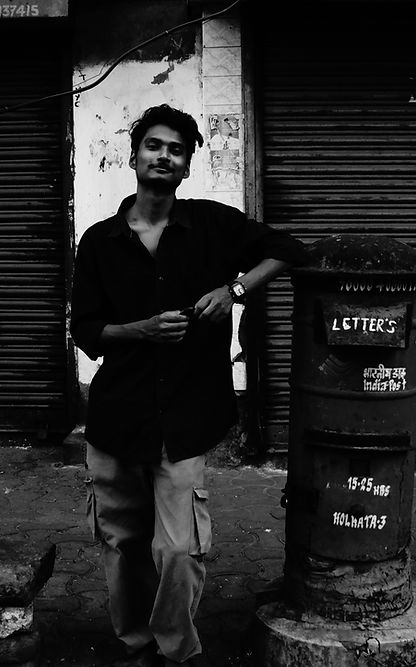
Election Fieldwork, Kolkata '26
About!!
Researcher: Filmmaker: Chronicler
I am a researcher of media, power, and political communication, and a prospective PhD candidate working at the fault lines of democracy, technology, and ideology in contemporary South Asia. My work interrogates how narratives are manufactured, circulated, and weaponized, particularly through digital infrastructures and propaganda literature to produce consent, consolidate majoritarian politics, and reshape public discourse.
Trained in Mass Communication and Journalism, and currently a Research Fellow at Jadavpur University, my research spans disinformation, hate speech, electoral politics, and the cultural afterlives of political movements. I have worked extensively on tracking organized hate and conspiracy networks, combining computational tools with critical theory to map the architectures of digital propaganda.
Alongside this, my field-based work on "Mapping Sufi Landscapes of Bengal" reflects a parallel intellectual commitment: to recover plural histories, vernacular knowledge systems, and forms of resistance that exist outside statist and majoritarian frameworks. This dual engagement, between the study of exclusionary politics and the documentation of syncretic traditions, shapes the core of my academic orientation.
My interventions, whether in research, writing, or public discourse, are anchored in a critical position: that the media is not merely a site of representation, but a terrain of struggle. I am interested in how power operates through language, how marginal voices are erased or co-opted, and how alternative narratives can be forged in response.
ONGOING RESEARCH PROJECTS
1. Social History of Mazars in Bengal
This project, funded by the Department of Minority Affairs and Madrasah Education, Government of West Bengal, undertakes a comprehensive study of the social history, architectural evolution, and socio-cultural significance of Mazars across the state.
Led by Dr. Abdul Matin as Principal Investigator and Sandip Nayak as Co-Principal Investigator, the study combines archival research, fieldwork, and visual documentation to map approximately fifty Mazars across West Bengal. Click here to read more.

Tentative cover of upcoming coffee table book.
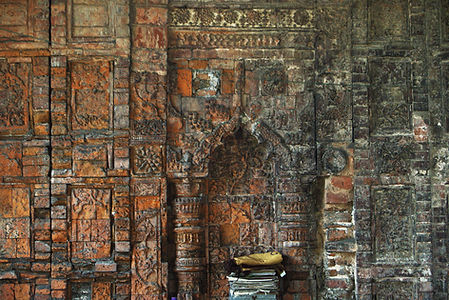
Architectural design at Zafar Khan Ghazi Dargah and Mosque.

Stone Inscriptions at Ata Shah Dargah, Gangarampur, Dakshin Dinajpur.

Earliest Surviving Muslim Monument in Bengal. Mosque of Zafar Khan Ghazi at Tribeni, Hooghly.

Mazar of Syed Shah Abdullah Kermani (R.A.), popularly known as Khustigiri Darbar Sharif, Illambazar, Birbhum district.
2. Inscribing Politics: Graffiti, Identity, and Electoral Narratives in Bengal '26
Political graffiti in Bengal is not merely decorative or propagandist; it is deeply embedded in the region’s political culture. These walls speak of promises made and broken, of shifting ideological currents, of linguistic pride, and of grassroots creativity that blurs the boundary between art and political communication. As West Bengal approaches its upcoming elections, the walls across the state have once again transformed into vibrant arenas of political expression, where poems, couplets, limericks, caricatures, and bold strokes of colour narrate competing visions of power, identity, and belonging. Click here to read more.

A wall grafiti in Kalighat area of Kolkata.
3. Denied at the Door: Housing Discrimination in University Towns of West Bengal
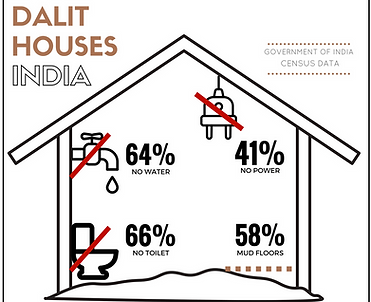
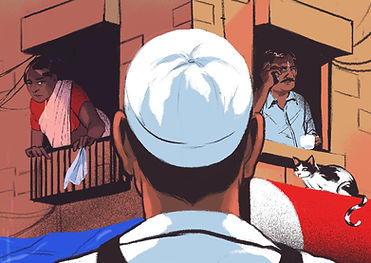
This project examines the entrenched patterns of housing discrimination in university areas across West Bengal, focusing on how students from lower-caste backgrounds and religious minority communities are systematically excluded from accessing safe and affordable accommodation. Despite education being framed as a pathway to mobility, the denial of housing reveals how caste and religious prejudices continue to shape everyday urban life. Through fieldwork, interviews, and documentation of rental practices, the study highlights how informal screening, stigma, and bias operate in student neighborhoods, often forcing marginalized students into precarious, segregated, or distant living conditions. By foregrounding housing as a fundamental right, the project seeks to expose these invisible barriers and contribute to a broader conversation on equity, dignity, and access within higher education spaces. Click here to read more.

Recent News and Updates !!
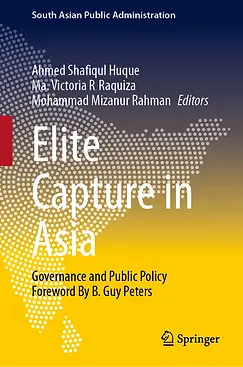
Cover of the Book: Elite capture in Asia: Governance and Public Policy
Forthcoming Title: Extracting the State: Caste Networks, Crony Capitalism, and the Legal Architecture of Elite Capture (July, 2026)
I am pleased to share that the upcoming volume, Elite Capture in Asia: Governance and Public Policy, to be published by Springer Link as part of the South Asian Public Administration (SAPA) series, will include a chapter co-authored with Dr. Abdul Matin.
Titled “Extracting the State: Caste Networks, Crony Capitalism, and the Legal Architecture of Elite Capture,” the chapter examines how contemporary financial governance in India is reshaping democratic institutions. It argues that economic power and caste hierarchies function as deeply intertwined systems, reinforcing each other within the political economy.
Focusing on the Electoral Bond Scheme and the PM CARES Fund, the chapter shows how financial opacity, corporate-political collusion, and weakening of formal accountability mechanisms institutionalize elite capture.
Bringing together insights on extractive institutions and state capture, the chapter introduces the theory of "caste-embedded crony capitalism", highlighting how contemporary political finance regimes normalize elite dominance in India’s democracy.

SIR form submissions underway in Lalgola, Murshidabad, West Bengal
When democracy erases its own citizens
The article “When democracy erases its own citizens” in Links International Journal of Socialist Renewal offers a critical lens on contemporary citizenship regimes in India. It portrays the SIR (Special Intensive Revision) process not as a neutral administrative exercise, but as a mechanism that can render already vulnerable populations uncertain, scrutinized, and at times excluded from the democratic fold.
By situating SIR within broader practices of documentation, verification, and surveillance, the piece argues that such processes risk transforming citizenship into a conditional status, one that must be continuously proven. In doing so, it highlights how democratic institutions can help narrow, rather than expand, the boundaries of belonging.


Annapurna Bhandar and Its Politics of Discontents
Our latest article, "Annapurna Bhandar and Its Politics of Discontents", explores a question that goes beyond welfare delivery: What happens when access to social benefits becomes tied to extensive documentation, household profiling, and citizenship verification?
Using the newly introduced Annapurna Bhandar scheme in West Bengal as a case study, we argue that welfare today is increasingly functioning not only as a redistributive mechanism but also as a tool of classification and governance. The debate, therefore, is not simply about cash transfers or administrative efficiency. It is about how states define eligibility, citizenship, and belonging.
By drawing a comparative link with Denmark's AI-driven welfare monitoring system, the article highlights a broader global trend: the growing convergence of welfare, data extraction, surveillance, and citizenship verification.
The piece invites readers to think critically about the future of democracy and welfare in an age where documentation increasingly determines recognition, inclusion, and access to rights.